
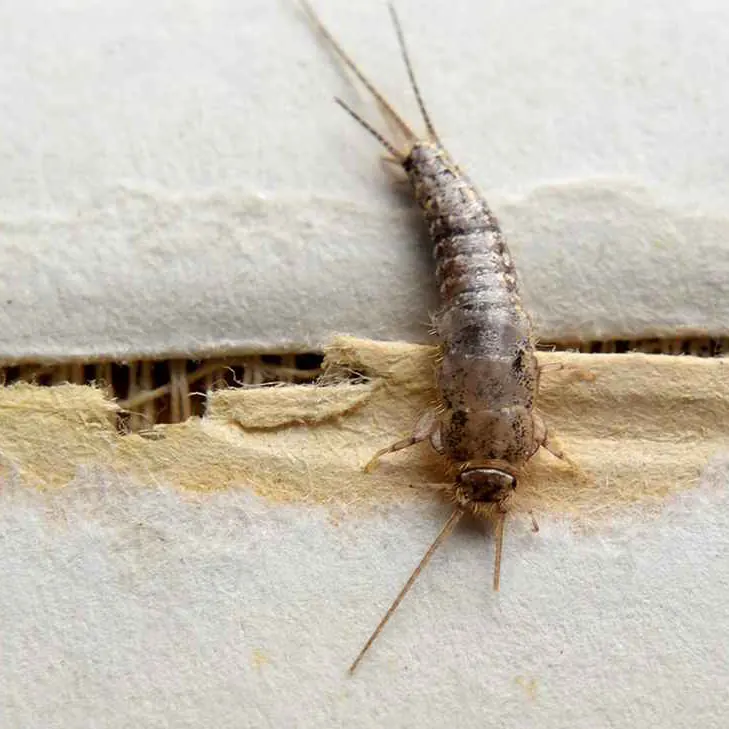
Fishmoths are a moisture problem first and an insect problem second. They need humid air to survive, which is why they do so well in Bluewater Bay, with the beach on one side and the Swartkops estuary on the other. Treat the cupboards and shelves where they hide and they'll drop away fast, but unless the damp is dealt with, they'll be back. We do both: a targeted treatment and practical advice on drying the space out.
What fishmoths actually are
Fishmoths, also called silverfish, aren't moths at all. They're small, wingless, carrot-shaped insects with a silvery, scaly body and three long bristles at the tail. They move in quick, wriggling bursts and come out at night. They feed on starch and cellulose: paper, book bindings, wallpaper glue, photographs, cardboard, cotton and linen, and food crumbs like flour and cereal.
They live a long time and breed slowly, so a large population usually means they've been undisturbed for a while.
Why Bluewater Bay suits them
Coastal air and the estuary keep humidity up for much of the year. Inside the house, that shows up in the places where air doesn't move: built-in cupboards against outside walls, the cupboard under the stairs, linen cupboards next to the bathroom and wardrobes that stay closed all winter.
The garage is the other big one. Boxes of old school books, photo albums, holiday decorations and paperwork in cardboard boxes on a concrete floor make an ideal fishmoth home. Concrete pulls in damp, cardboard soaks it up, and the contents are food.
Signs of fishmoths
- Silvery insects darting away when you move a box or open a drawer
- Irregular holes, notches or thin patches in paper, book pages, wallpaper and labels
- Yellowish stains on stored clothes and linen
- Tiny pepper-like droppings and shed silvery scales on shelves
- Damage to photos and documents in boxes or albums
How we deal with them
- Find the hiding places. Cupboards, shelving, roof space where accessible, behind skirtings and in storage areas.
- Targeted residual treatment. An odourless, non-staining spray into cracks, cupboard corners, behind shelving and along skirtings, where fishmoths shelter during the day. It won't mark clothes or books.
- Garage and storage treatment where the infestation is coming from.
- Moisture advice. We look for the causes: a leaking pipe in a cupboard, a bathroom without proper ventilation, or a cupboard against a damp wall.
You don't need to move out, and nothing needs to be thrown away. Keep children and pets out of treated areas until surfaces are dry.
Protecting what you can't replace
The real cost of fishmoths is often sentimental: old family photos, letters, a child's first school books or documents you need to keep. Go through anything stored in cardboard, look for notching and yellow marks, and move what matters into sealed plastic containers with a sachet of silica gel. Keep important papers in the house rather than the garage, ideally in a cupboard on an inside wall. If you find small, pale insects even tinier than fishmoths on old paper, those may be booklice, which also follow damp and are dealt with the same way: dry the space out and clear the mould they feed on.
What people get wrong
Using mothballs. Mothballs are aimed at clothes moths, a completely different insect, and they do very little against fishmoths. They also leave a strong smell in everything. The damp and the cardboard are what need to go.
A local tip
Swap cardboard boxes in the garage for sealed plastic crates and lift them off the concrete onto shelving. Leave built-in cupboard doors open for an hour on dry, windy days to let the air through. In a house this close to the water, a moisture absorber in the linen and wardrobe cupboards is also money well spent.
What does it cost?
It depends on how many rooms and cupboards are affected, whether the garage and storage areas need treating too, and how big the house is. A few fishmoths in one cupboard can often be sorted by drying the cupboard and moving things into plastic, and we'll tell you if that's the case. A house-wide problem with damage to books and clothes needs a full treatment.
Fishmoths are one of several insects that turn up indoors here; our page on crawling insects in Bluewater Bay houses covers the others. We also treat fishmoths throughout Port Elizabeth and offer fishmoth control in Despatch. See pest control in the suburb for everything else.
Call 087 012 5550, or WhatsApp us a photo of the insect or the damage and we'll tell you what it is.
Questions we get asked
Are fishmoths harmful to people?
No. They don't bite or carry disease. The harm is to books, papers, photos, clothes and stored items.
Why do I have fishmoths in a new house?
They often arrive in boxes during a move, and new homes can stay damp while plaster and concrete dry out. Both give them a head start.
Will the spray stain my clothes or books?
No. We use odourless, non-staining products and apply them to cracks, corners and behind shelving, not onto your belongings.
Do fishmoths fly?
No. Despite the name, they have no wings. They run quickly along floors, walls and shelves.
Can I get rid of fishmoths myself?
For a small problem, yes. Dry out the cupboard, move items into sealed plastic containers and vacuum the corners. If they're throughout the house, a treatment helps.
Why are they worse in winter?
Cupboards stay closed and the house is less ventilated in winter, so humidity rises in exactly the spots fishmoths like.