
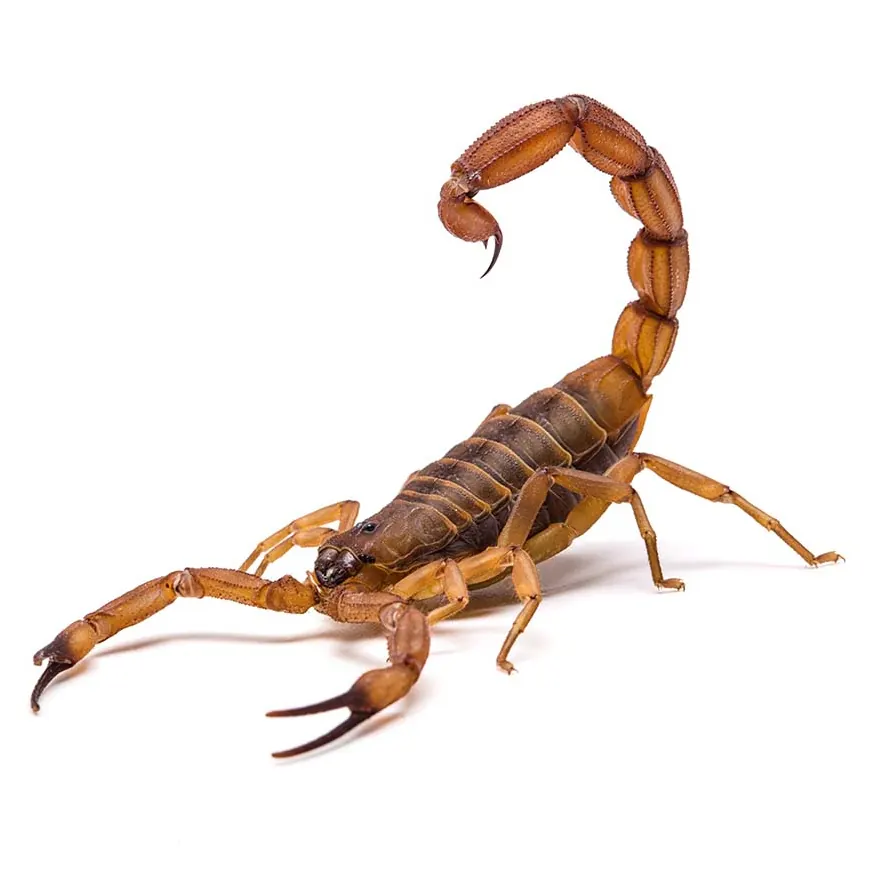
If you're finding scorpions indoors or around the house in Port Elizabeth, it usually means there are good hiding places close by and plenty of insects to eat. The way to reduce them is to take away the shelter, cut down their food and put a barrier treatment where they come in. Scorpions are tougher than most pests and won't vanish after one spray, but most homes can get them down to a rare sighting. Here's what's involved.
Which scorpion is it? A rule of thumb
Look at the pincers and the tail.
- Small pincers, thick tail: treat with caution. These are the thick-tailed scorpions, and their sting can be serious, especially for children, older people and anyone with health problems.
- Big pincers, thin tail: usually burrowing or rock scorpions that rely on their pincers to catch prey. A sting is painful but generally much less serious.
This isn't a perfect test, but it's a good starting point. If in doubt, take a photo from a safe distance and send it to us.
Why scorpions turn up here
The Eastern Cape has a good variety of scorpions, and they're more common on the edges of the metro where suburbs meet bush, veld and smallholdings. Coastal bush and fynbos on the western side of the city, open land in the northern areas, and the hotter, drier conditions inland around Kariega and Despatch all suit them. In established suburbs, they tend to live in garden walls, rockeries, wood piles, under paving and in garages.
Scorpions are nocturnal. They hunt insects at night and hide during the day, which is why you find them in shoes, towels, under mats and in folded clothes left on the floor.
Signs of scorpions
- Scorpions found indoors, often in bathrooms, garages, laundries and near doors
- Scorpions under stones, pots, bricks, logs or garden furniture
- Small burrows at the base of walls or in sandy soil, especially with burrowing scorpions
- Lots of insects around outside lights, which is a food source
A handy trick: scorpions glow a greenish-blue under an ultraviolet torch. A walk around the garden after dark with a UV torch shows how many you really have and where they're living.
How we reduce scorpions
- Inspection. We look for their hiding places around the house, garden walls, wood piles, rockeries, garages and outbuildings, and for gaps where they're getting in.
- Barrier treatment. We apply an odourless, non-staining residual spray around the outside of the house, at door and window thresholds, along the base of walls, and into crevices and hiding spots. Indoors, we treat garages, laundries and other areas where they've been found.
- Reducing their food. Scorpions eat insects. Treating crawling insects around the house and changing outside lights helps cut down their food supply.
- Advice on harbourage. We show you what to move or clear. This step matters as much as the treatment.
You don't need to leave home. Keep children and pets off treated surfaces until they're dry.
What people get wrong
Expecting a spray to work like it does on cockroaches. Scorpions have a tough outer covering and can go a long time without feeding, and many hide deep in cracks the spray can't reach. A barrier helps a great deal, but if the wood pile, loose bricks and rubble stay against the house, scorpions keep living there. The treatment and the clean-up need to go together.
Prevention that makes a real difference
- Move wood piles, bricks, pots and rubble away from the house walls
- Fit brush strips or seals under external doors
- Fill gaps in walls, around pipes and in paving near the house
- Shake out shoes, boots and towels left outside or on the floor
- Don't let children walk barefoot in the garden at night
- Keep beds pulled away from walls if you're finding scorpions in bedrooms
A tip for homes near bush
Check the garden walls. Many older stone and brick boundary walls in the Bay have gaps and loose mortar along the bottom, and these are a favourite scorpion hiding place. Repointing or sealing the base of a wall that runs close to the house is one of the most useful things you can do.
If someone is stung
Stay calm, keep the person still and get medical help, particularly for children, the elderly or anyone with a thick-tailed scorpion sting or a strong reaction. A photo of the scorpion can help the doctor. We deal with the scorpions; medical questions are for a doctor.
What does scorpion control cost?
The price depends on the size of the property, how much bush, rockery and boundary wall there is, and how many outbuildings need treatment. A normal suburban house with occasional scorpions is a smaller job than a smallholding backing onto bush. Some properties benefit from a seasonal treatment each year, usually before the warmer months.
Spiders often share the same hiding places, so read about spider control in the Bay too. For the hotter inland towns, see scorpions in Kariega and scorpion treatment in Despatch. Smallholdings with bush on the boundary are covered on our page for pest control in Theescombe.
Call 087 012 5550, or WhatsApp us a photo of the scorpion and we'll help you identify it.
Questions we get asked
Which scorpions are dangerous?
As a rule, scorpions with small pincers and a thick tail are the ones to be careful of. Large pincers and a thin tail usually mean a less serious sting.
Why do I find scorpions in the bath?
They wander in at night looking for moisture or prey and can't climb out of the smooth sides. It usually means they're getting in under doors or through gaps nearby.
Can you get rid of scorpions completely?
In homes near bush, not completely, but treatment and clearing their hiding places can reduce them to an occasional sighting.
When are scorpions most active?
On warm nights, especially in summer. That's also when people tend to find them indoors.
Is a UV torch useful for finding scorpions?
Yes. Scorpions glow under ultraviolet light, so a walk around the garden at night with a UV torch shows where they're living.