
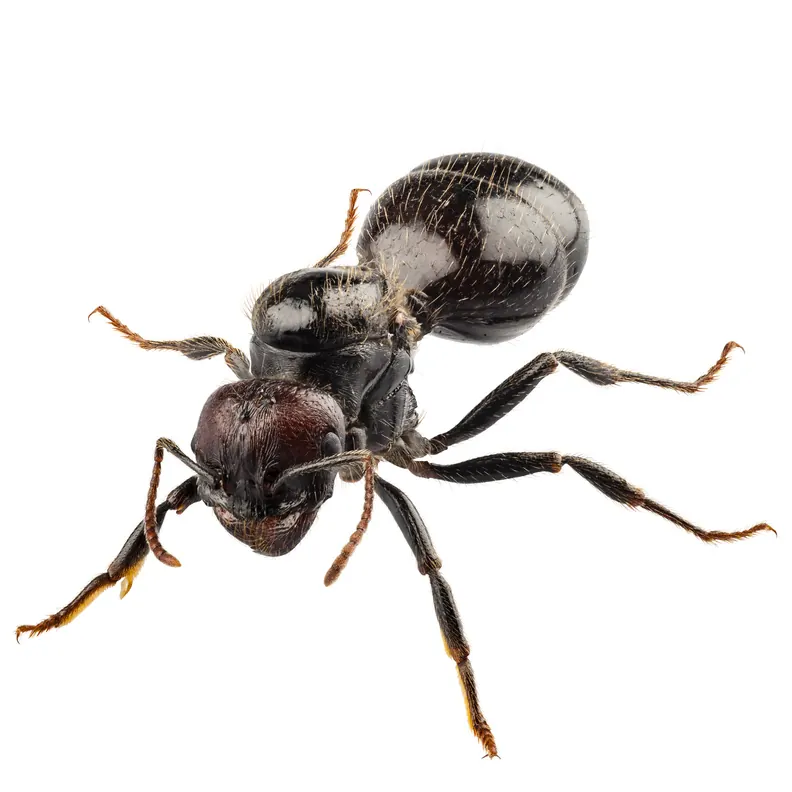
Ants keep coming back because the nest is still alive. The workers you see on the counter are foragers. Behind them, somewhere under the paving, inside a wall cavity or beneath the kitchen floor, there's a nest with one or more queens laying eggs every day. Kill the foragers and the nest just sends more. The way to clear ants in Port Elizabeth homes and businesses is to feed the colony a slow-acting bait that workers carry home and share, so it reaches the queen. That's the core of how we treat them.
The ants that turn up in Bay homes
Several different ants come indoors here, and not all of them respond to the same bait.
- Small brown house ants are the common trailing ants in kitchens and bathrooms. They form long lines to anything sweet or greasy and often nest under paving, in wall cavities and below floors.
- Larger black ants, often called sugar ants, tend to forage at night and nest in soil, wood or wall voids. You'll see a few big ants wandering rather than a tight trail.
- Tiny ants in pet food or the bin are often protein feeders. They ignore sugar baits completely and need a different bait.
Part of our job is working out what the ants are feeding on, because a sweet bait offered to a protein-hungry colony does nothing.
Why ants are so persistent here
Sandy garden soil, common in coastal suburbs, is easy for ants to dig and drains well, so nests can get big. Mild winters mean colonies don't die back much. And rain is the trigger. When a heavy downpour floods their nests, ants move inside looking for dry ground and food, and suddenly there's a trail up the kitchen wall that wasn't there yesterday.
Gardens matter too. Ants farm aphids and scale insects on plants for the sweet honeydew they produce, so a garden full of infested shrubs or citrus trees often has busy ant colonies right beside the house.
Signs of an ant problem
- Trails along skirtings, worktops, window frames or electrical cables
- Small piles of fine sand or soil coming from gaps in paving, tiles or skirting
- Ants inside electrical boxes, plug points or appliances
- Ants in the sugar bowl, pet food or the dustbin
- Winged ants appearing indoors, which can mean a nest inside the building
How we get rid of ants
- Follow the trail. We track ants back from where they're feeding to where they're entering, and as close to the nest as we can get.
- Identify and bait. We place ant bait along trails and at entry points, choosing a bait the ants will actually take. Workers carry it back to the nest and share it.
- Barrier treatment where it helps. An odourless, non-staining residual spray can be applied outside around the base of walls and at entry points, especially for ants coming in from the garden. We're careful not to spray right on top of bait.
- Nest treatment. Where a nest can be found, in paving or soil, we can treat it directly.
- Follow-up if needed, for large or multiple colonies.
You don't need to leave the house. Keep children and pets off sprayed areas until they're dry.
The mistake that spreads ants around
Spraying the trail with a household insecticide. The trail vanishes, but the nest survives. With some house ants, a disturbed nest splits into several smaller colonies, each with its own queen, and you end up with ants in three rooms instead of one. The other mistake is wiping out bait trails with surface cleaner while the bait is working. Let them feed for a few days. More ants around the bait at first is a good sign.
A tip for Port Elizabeth gardens
Check the plants next to the house for aphids and scale, especially roses, citrus and young growth after rain. If you see ants running up and down a stem, they're farming. Dealing with the sap-suckers on those plants takes away one of the colony's main food sources and makes the bait inside far more attractive.
Ants in businesses
In food premises, ants contaminate products and workspaces, and they can get into sealed-looking packaging. In offices and factories, they nest in electrical cabinets and cable trays, where they can cause faults. Businesses with recurring ant problems benefit from a regular service with ongoing baiting and inspection rather than reacting each time a trail appears.
What does ant control cost?
The price depends on how many colonies there are, how far they've spread through the building, and whether the nests are inside or out. A single kitchen trail is a small job. Ants nesting in the walls of a large house, or through a business, takes more time and usually a follow-up. If it's a small trail from a single sugar spill, a careful clean and a store-bought ant bait from the hardware shop may be enough, and we'll tell you so. Otherwise, we quote after we've had a look.
For more detail on ant behaviour, see the complete ant guide. Ants are also a big part of the work in our local pages on ants in Bluewater Bay gardens and homes and ant control in Jeffreys Bay. If you're seeing cockroaches as well, read about clearing cockroaches in PE.
Call 087 012 5550, or WhatsApp us a close-up of the ants and where they're trailing to.
Questions we get asked
Why are there more ants after the bait was put down?
That's normal at first. Ants are recruiting others to the bait, which is exactly what we want. Numbers should drop over the following days as the bait reaches the nest.
Why do ants come inside after rain?
Heavy rain floods their nests in the soil, so they move to dry ground and look for food. Homes are often the nearest dry place.
Can ants damage electrical equipment?
Yes. Some ants nest in plug points, DB boards and appliances, and their bodies and nest material can cause faults.
Are ant baits safe with pets around?
Bait is used in small amounts and placed where ants feed, out of the way of pets. We'll show you where it is.
How long does it take to get rid of ants?
Bait usually takes several days to a couple of weeks to reach the queen and clear the colony, depending on its size and how many nests there are.