
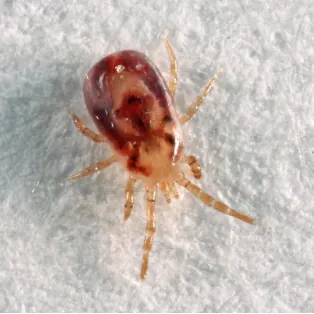
Bird mites are one of the most misunderstood pests we deal with in Port Elizabeth. People are often convinced they have bed bugs or fleas and spend weeks treating mattresses and carpets, while the real cause is a bird's nest in the roof right above the bedroom. Bird mites live on nesting birds and their chicks. When the chicks leave the nest or the nest is abandoned, the mites lose their food supply and go looking for another one. They crawl down through ceilings, light fittings and air vents and bite people. The cure is to find and treat the nest, treat the rooms where the mites are, and close the gap that let the birds in.
What are bird mites?
Tiny mites, smaller than a full stop, that feed on the blood of birds. Unfed, they're pale or almost see-through; after feeding, they turn reddish or dark. They move fast and are often seen as tiny moving specks on white surfaces, such as a basin, a white wall, a ceiling or a bedside table near a light. They can't live and breed on people; without a bird host, they die off in a matter of weeks. But in that time, they can make life miserable.
Why PE has so many bird mite problems
Port Elizabeth is called the Windy City for good reason. Strong winds lift roof tiles, loosen ridge capping, peel back the edges of roof sheeting and create gaps at the eaves and fascia boards. Pigeons, mynas, sparrows and starlings use those gaps to get into roof spaces and gutters, where they find warm, dry, sheltered spots to nest. Air conditioning units, solar panel mountings, signs and ledges on buildings are also popular nesting places.
Spring and early summer are the main nesting seasons, so bird mite calls tend to follow a few weeks later, when the chicks have fledged and the mites are left behind.
Signs it's bird mites
- Itchy bites, sometimes all over, sometimes concentrated on the upper body
- A crawling, tickling feeling on the skin, especially at night
- Tiny moving specks near light fittings, air vents, ceiling cornices, window frames and on white surfaces
- Bites mainly in one or two rooms, usually directly under the nest site
- Birds recently nesting in the roof, gutters, eaves or air conditioning unit, then gone
- Bed bug and flea treatments haven't helped
How we treat bird mites
- Find the nest. We inspect the roof space, eaves, gutters, air conditioning units and other likely sites, focusing on the area above the rooms where bites are happening.
- Treat the nest. A targeted treatment on the nest kills the mites at their source. Where it's safe and the nest is no longer in use, we remove the nest material.
- Treat the affected rooms. We treat the ceilings, cornices, light fittings, window frames, skirtings and furniture in the rooms below, where mites have spread.
- Advise on bird proofing. We show you exactly where the birds are getting in, so you can have the gap closed. Without this step, birds nest in the same spot next season and the cycle repeats.
You don't need to leave the house. Keep children and pets off treated surfaces until they're dry.
The mistake that drags things out
Removing the nest yourself and doing nothing else. Taking down the nest removes the mites' last food source, and if the rooms below aren't treated at the same time, you can get a surge of mites coming down into the house looking for a new host. Nest removal and room treatment need to happen together. The other mistake is treating for bed bugs or fleas when the timing and location point to birds.
A local tip
After a big windstorm, look at your roof line from the garden, particularly the ridge, the edge tiles and where the roof meets the gutter. If you can see a gap or a lifted tile, and especially if you notice birds flying in and out, have it fixed before nesting season. A small repair in winter can save you a miserable summer.
Bird mites in businesses
Offices, warehouses, factories and shopping centres with large roofs, signage and air conditioning plant are prone to birds nesting, and staff complaints about bites can follow. We inspect nest sites, treat mites at the source and in affected areas, and can advise on proofing high-risk spots like signage and rooftop units.
What does bird mite treatment cost?
The price depends on how easy the nest is to reach, how many nests there are, and how many rooms need treatment. A single nest in an accessible roof space above one bedroom is a fairly simple job. Several nests across a large roof, or in high or awkward places, take longer. Bird proofing work, such as fixing tiles or fitting mesh, is usually done separately by a roofer or builder.
For more detail, read our bird mite guide. If you're still not sure what's biting, compare with bed bugs in Port Elizabeth or our overview of biting insect problems. We also have local pages for bird mites in Newton Park and bird mite treatment in Walmer.
Call 087 012 5550, or WhatsApp us a photo of the bites, the specks you're seeing or where birds have been nesting.
Questions we get asked
Can bird mites live on people?
No. They bite people but can't complete their life cycle without a bird host. Once the nest is treated and removed, they die off.
How do I know it's bird mites and not bed bugs?
Bird mites are far smaller and often seen near light fittings, vents and ceilings rather than in the bed. Recent nesting birds in the roof are the biggest clue.
Should I remove the nest myself?
It's better not to. Removing the nest without treating the rooms below can push more mites into the house.
When are bird mites most common?
A few weeks after the spring and early summer nesting season, when chicks have left the nest and the mites go looking for food.
How do I stop it happening again?
Close the gap the birds are using to get into the roof. We'll show you where it is; a roofer or builder can usually seal it.