
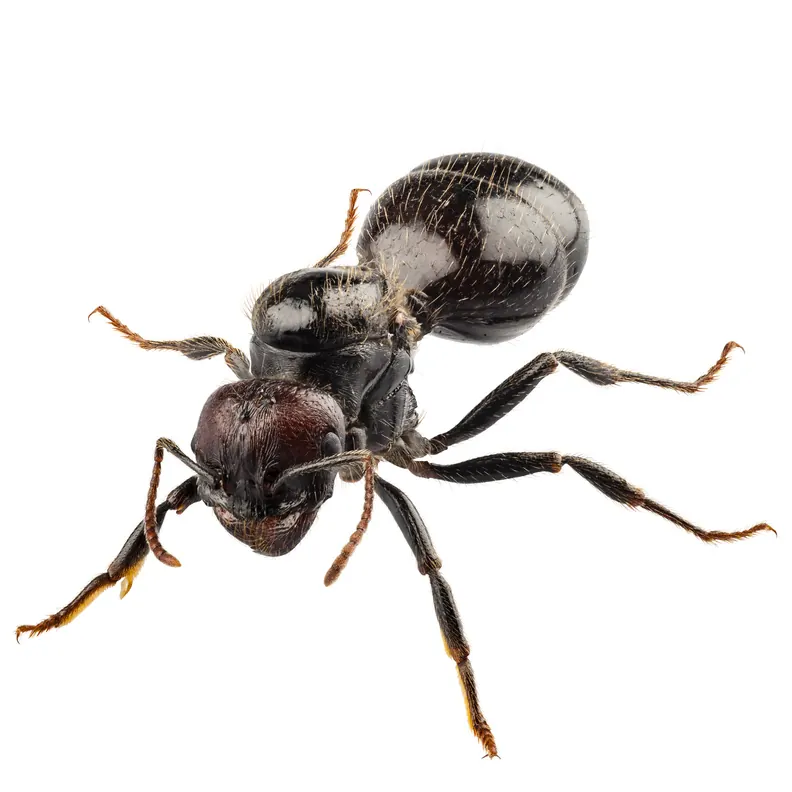
If ants keep coming back to your Jeffreys Bay kitchen no matter how often you wipe the trail away, it is because the nest is untouched. Ants you see are a small share of the colony; the rest, including the queens, are underground or in a wall void. The way to clear them is a bait that the workers carry home and share. That is the core of every ant job we do here.
Why J-Bay has so many ants
The soil in town is largely sand, and sand is easy to dig, drains quickly and warms up fast in the sun. Ants love it. Colonies set up under paving, along the base of walls, beneath patio slabs and around the roots of garden plants. The paving sand between bricks is especially popular, which is why you see neat little heaps of fine sand appearing between pavers after a few warm days.
Fynbos and dune vegetation around the edges of town support plenty of ants too, and they forage into gardens and houses that back onto it. Inside, they move through wall cavities, conduit and gaps behind skirting boards.
When they invade
Ants come inside for food, water or shelter. In J-Bay we see a few patterns:
- After rain, when nests in sandy soil flood and colonies move indoors to drier spots.
- When a closed house fills up, and suddenly there is fruit on the counter, sugar in the tea tin and crumbs from a dozen people.
- In hot, dry spells, when they come looking for water around sinks, basins and pet bowls.
- In electrical fittings, where some species nest inside plug points, switches and distribution boards.
Signs to look for
- Steady trails along skirting boards, worktops or window frames
- Sand heaps between pavers or along the edge of the house
- Ants streaming out of a plug point or light switch
- Winged ants appearing indoors, which usually means a mature colony nearby
- Ants in pet bowls, sugar containers and the fruit bowl
How we clear them
- Identify the ant and follow the trail. Different species prefer sugary or protein baits, so knowing which ant you have decides what we use. We trace the trail outside to the nest where we can.
- Bait placement. Ant baits go along trails and near entry points. Workers take it back to the nest and feed it to the queens and young.
- Nest and perimeter treatment. Where we can reach nests in paving or soil, we treat them directly, and an odourless residual barrier around the house cuts down new invasions.
- Electrical fittings. We treat around plug points and switches carefully. If ants have got into a distribution board, have an electrician check it.
- A check-back if the colony is large or there are several nests.
Nobody has to leave the house. Keep children and pets away from sprayed areas until they dry.
A local tip
When you top up or relay paving, use a sand-and-cement or polymeric jointing mix rather than loose building sand in the joints. Loose sand is a ready-made ant nest. It is a small change that makes a real difference in a sandy town.
What people get wrong
Spraying the trail with insect spray or wiping it with bleach. It kills the workers you can see, but the nest carries on, and some ant species respond to a spray by splitting into several new colonies. You end up with more trails, not fewer. Also avoid spraying near baits once they are down; ants will not take contaminated bait.
Holiday homes and guest units
Ants are one of the most common complaints from guests in self-catering accommodation, mostly because one sticky glass on a counter will draw a trail overnight. A perimeter treatment before the season, with baits placed in the kitchen, keeps most of them out. Ask guests to keep food in sealed containers and wipe surfaces before bed.
What does ant control cost?
A small trail in a kitchen can often be fixed with good-quality shop-bought ant bait placed along the trail and left alone for a few days; we will tell you honestly if that is all you need. The cost of a professional treatment depends on the size of the property, the number of nests, the species and whether a perimeter barrier is needed. Ants in electrical fittings or in several units of a complex take more work. We quote after a look.
Ants often come with other kitchen pests; see our J-Bay cockroach treatment page if you are seeing both. Read more in our guide to ants and ant baiting, see how we handle ant colonies in Walmer gardens, or go to our main ant control for Port Elizabeth page. For the rest of what we do locally, there is our Jeffreys Bay pest control overview.
Call 087 012 5550, or WhatsApp us a photo of the ants and the trail.
Questions we get asked
Why are there little heaps of sand between my pavers?
Ants are digging out their nest underneath and carrying the sand up. Treating the nest directly and using a firmer jointing mix stops it.
Can ants damage electrical fittings?
Yes. Some species nest in plug points and switches and can cause faults. We treat around the fitting, and an electrician should check any affected distribution board.
How long do ant baits take to work?
Usually a few days to two weeks. You may see more ants at first while they collect the bait, which is a good sign.
Why did ants appear as soon as we arrived at our holiday house?
They were already nesting nearby and found food the moment it appeared. A perimeter treatment before you arrive helps a lot.
Are flying ants the same as termites?
No, but they are easy to confuse. Flying ants have a narrow waist and front wings longer than the back ones. Send us a photo if you are unsure.