
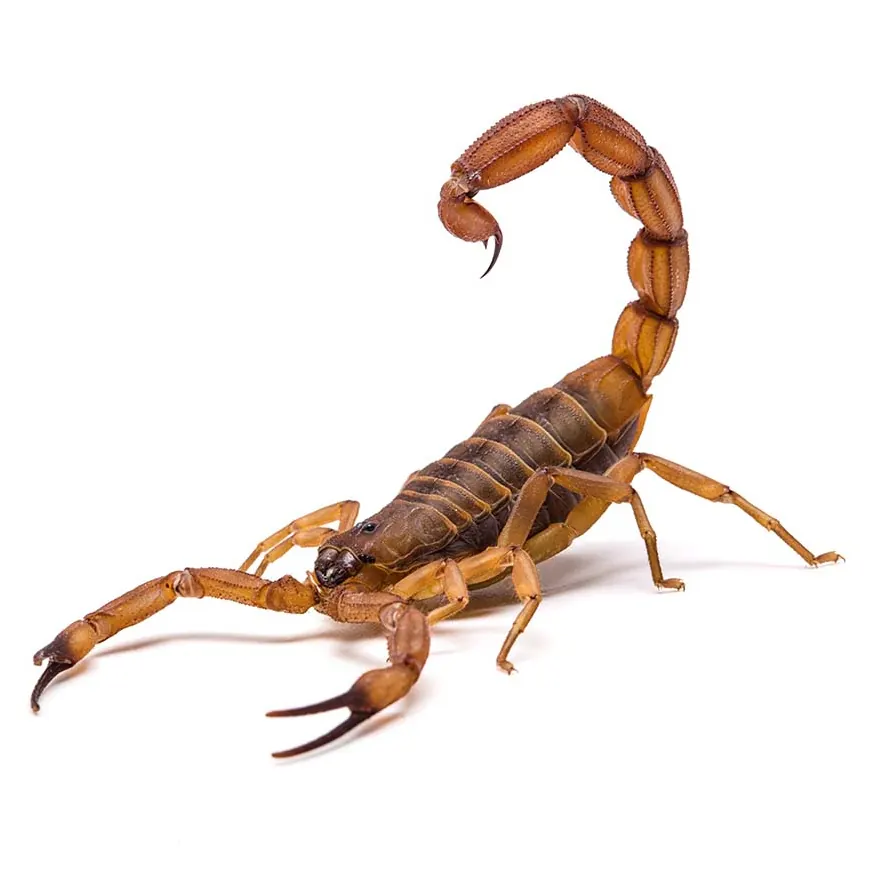
Scorpions turn up in Jeffreys Bay because the town is built on their kind of ground: sandy soil, dune vegetation, fynbos, rocks and plenty of insects to eat. Most of the ones people find are not dangerous, but some are, and you cannot always tell by size. The sensible approach is to know which type you are seeing, reduce the hiding places around the house and treat the areas where they enter and shelter.
How to tell them apart
The simplest rule used in South Africa is to look at the pincers and the tail.
- Big pincers, thin tail. These are usually burrowing scorpions. They dig into sandy ground and rely on their claws to catch prey. A sting is painful but generally not dangerous.
- Small, slender pincers, thick tail. These are the thick-tailed scorpions, and they carry stronger venom. A sting can be serious, especially for children, the elderly and anyone with a health condition, and needs medical attention.
If you are unsure, do not handle it. Trap it under a glass, take a photo and send it to us on WhatsApp.
Why scorpions come close to J-Bay houses
Burrowing scorpions do well in sand, and much of the town's soil is sandy. Gardens that run into dunes or fynbos have scorpions living right up to the wall. Around the house they look for cool, sheltered spots during the day: under paving slabs, rocks, logs and firewood, in gaps in boundary walls, under pot plants and in the clutter around pool pumps and outdoor showers. At night they come out to hunt the insects drawn to outside lights.
Beach life adds a few hazards of its own. Shoes, wetsuits, booties and towels left on the stoep overnight make perfect daytime shelters. So do boxes and gear stacked on the garage floor.
Signs of scorpion activity
- Scorpions found indoors, especially in bathrooms, near doors and in shoes
- Small burrows in sandy patches, often at the base of rocks or walls
- Scorpions seen on walls or paving at night
- Pets pawing at something on the patio after dark
A tip that many people find useful: scorpions glow under ultraviolet light. Walk the garden with a UV torch an hour or two after dark and you will quickly see how many there are and where they are coming from.
How we deal with scorpions
- Inspection and identification. We look at the garden, walls, paving, outbuildings and points where scorpions could enter, and identify what type you have.
- Reduce harbourage. We show you which rocks, wood piles, rubble and stored items near the house are giving them shelter.
- Barrier treatment. An odourless residual treatment is applied around the foundations, doorways, gaps in walls and other entry points, and to sheltered areas they use in the day.
- Indoor treatment of cracks, skirting boards and the gaps around pipes in bathrooms and kitchens where needed.
- Insect control. Fewer insects around the house means less reason for scorpions to hunt there.
You do not need to leave the house. Keep children and pets off treated areas until they are dry.
A local tip
Keep a shoe rack or a lidded box by the door for surf booties, sandals and kids' shoes, and shake out anything that has been outside before putting it on. It sounds basic, but a bootie left on the stoep overnight is one of the most common places people in J-Bay meet a scorpion.
The thing people get wrong
Assuming a big scorpion is the dangerous one. The large, chunky-clawed burrowers look fierce but are usually the milder ones. The slender-clawed, thick-tailed scorpions are smaller-looking and more dangerous. Judge by pincers and tail, not by overall size.
What does scorpion control cost?
The price depends on the size of the property, how much garden and boundary need treating, and how much harbourage is around the house. For many homes, clearing rock piles and firewood away from the walls and sealing gaps under doors makes the biggest difference and costs very little. A barrier treatment is worth it where you have young children, where thick-tailed scorpions have been found or where they keep coming indoors. We quote after an inspection.
Scorpions and spiders often share the same hiding places; see our J-Bay spider control page, and our page on crawling insects in Jeffreys Bay for the insects they feed on. We also treat scorpions in Walmer, and our scorpion control service in Port Elizabeth covers the rest of the metro. For an overview of local pests, see pest control in J-Bay.
Call 087 012 5550, or WhatsApp us a photo of the scorpion and we will tell you what it is.
Questions we get asked
What should I do if someone is stung?
Keep calm, keep the person still and get medical advice straight away, especially for a child or if the scorpion had a thick tail. Take a photo of the scorpion if you can do so safely.
Are the big scorpions in my garden dangerous?
Usually not. Scorpions with large pincers and a thin tail generally have milder venom. Thick-tailed scorpions with small pincers are the ones to be careful of.
Why do I find scorpions in the bathroom?
They come in under doors or through gaps around pipes looking for moisture and insects, and get trapped on smooth floors and in baths.
Can I stop scorpions coming into the house completely?
Not completely, but sealing gaps under doors, clearing hiding places near the walls and a barrier treatment cut it down a lot.
Do scorpions really glow under UV light?
Yes. Their outer shell glows under ultraviolet light, so a UV torch at night is a good way to see where they are.