
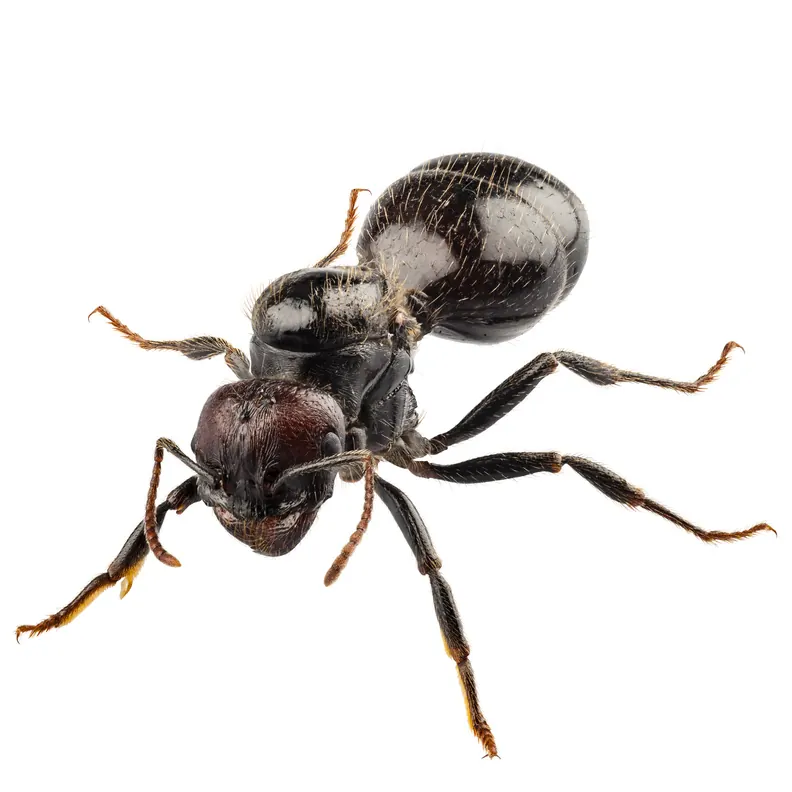
Ants in a Summerstrand home or flat are almost always coming from a nest outside, usually in the sandy soil under paving, lawn or the garden bed next to the wall. Spraying the trail on the kitchen counter kills a few workers and leaves the nest untouched. Bait that the workers carry back home is what actually solves it.
Sand makes for big colonies
Being a coastal suburb, much of Summerstrand is built on sandy ground, and ants love it. Sand is easy to dig, drains quickly after rain and warms up fast in the sun, so colonies grow large and spread out under paving, driveways and the edges of lawns. Little piles of fine sand pushed up between paving bricks are a giveaway: that's a nest entrance.
From there, ants follow anything that leads indoors: the edge of a wall, a cable entering the house, a gap under a sliding door or a pipe running up to a first-floor balcony. In apartment blocks we regularly find trails using wall cavities and electrical conduits to reach flats several floors up.
When they come inside
Ants tend to move indoors when conditions outside change. After heavy rain floods the nest, they head for higher, drier ground. In hot, dry spells they come in looking for water, which is why you'll find them around basins, shower drains and pet bowls as well as in the kitchen. And wherever there's sugar, they find it: a sticky cooldrink can in a student's room, honey on the counter, the sugar bowl on a guesthouse breakfast table.
Signs worth taking seriously
- Steady trails running in and out of the same gap day after day
- Ants inside plug points, light switches or the distribution board
- Sand piles appearing between paving bricks or along the base of walls
- Ants getting into containers you thought were sealed
- Winged ants appearing indoors, which can mean a nest inside the structure
How we treat ants
First, we follow the trail. It takes a bit of patience, but the nest location decides the treatment. Then we place ant bait on the active trails and near the nest. Worker ants carry it back and share it with the rest of the colony, including the queen, and that's what ends the problem rather than just thinning it. Around the outside, we can apply an odourless, non-staining residual barrier along the foundation and at entry points to stop new trails forming.
For a day or two after baiting you may see more ants than before, as they gather at the bait. Leave them to it. Wiping them away or spraying them stops the bait reaching the nest. Treated outdoor areas should be kept clear of children and pets until dry.
The mistake almost everyone makes
Spraying the trail with household insecticide. It kills the workers you can see, but with some species it can prompt the colony to split and set up new nests nearby, so one problem becomes several. It also leaves a residue the surviving ants avoid, which simply pushes them to find a different way in.
A tip for beachfront homes
Look at the joints in your paving, especially where the paving meets the house wall. Over time the jointing between bricks loosens and washes out, and the soft sand underneath becomes an easy home for a colony right against your foundations. Re-sanding or sealing those joints along the house is one of the cheapest things you can do to keep ants further away.
Restaurants, cafés and guesthouses
Ants on a breakfast buffet or in a café's sugar station are a bad look. For food businesses, we include ant treatment in a scheduled programme so trails are dealt with before guests notice. Bait in a food area goes into cracks and out-of-the-way spots, well away from preparation surfaces.
Ants in electrical fittings
Ants are oddly drawn to plug points, switches and distribution boards, and a large number packed inside can cause electrical faults. If ants are coming out of a socket, don't spray into it. Switch off at the board if it's safe to do so, call us to treat the colony, and have an electrician check the fitting if anything has tripped.
What does it cost?
It depends on how many nests there are, how far the ants have spread through the building and the size of the property. A single trail into a kitchen can sometimes be handled with good shop-bought ant bait, and we'll say so if that's your situation. Ants in a block of flats, inside walls or in electrical boxes are a bigger job. We quote after an inspection.
For more on ants, see our ant control guide or ant treatments across Port Elizabeth. Ants are one of several crawlers we deal with here, and our page on crawling insects in Summerstrand covers cockroaches and fishmoths too. The Summerstrand pest overview has the rest, and inland we also tackle ant problems in Walmer gardens.
Call 087 012 5550, or WhatsApp us a photo of the ants and we'll tell you what you're dealing with.
Questions we get asked
Why are there more ants after the bait goes down?
Because they're gathering to feed on it and carry it home. That's a good sign. Numbers usually drop off once the bait has reached the colony.
How long does ant bait take to work?
Usually a few days to a couple of weeks, depending on the size of the colony and how many nests there are.
Can you treat ants in an upstairs flat?
Yes. We trace the trail through the building to where it starts, which is often outside at ground level, and treat both the trail and the source.
Why do ants come in after rain?
Rain floods their nests in the sandy soil, so they move to higher, drier places, which often means your kitchen or bathroom.
Is the outdoor barrier treatment safe for my dog?
Yes, once it's dry. Keep your dog off the treated area until then.
Are ants in plug points dangerous?
They can be, because a mass of ants inside a fitting can cause a fault. Don't spray into the socket; have the colony treated and the fitting checked.