
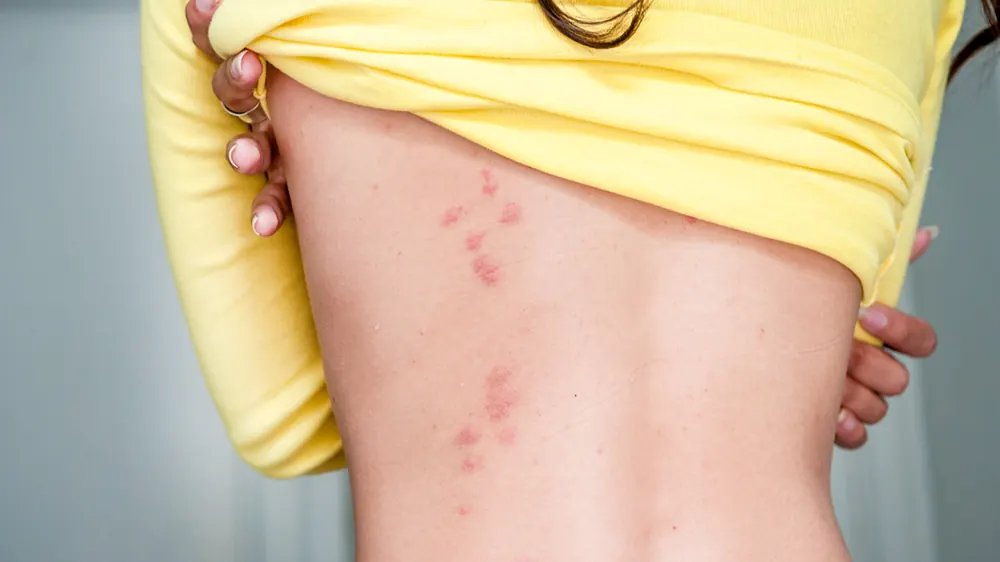
If you or your guests are getting bitten in Jeffreys Bay, the first job is to find out what is doing the biting. Bed bugs, fleas, bird mites and mosquitoes all leave itchy red marks, but they live in completely different places and need completely different treatments. Treat for the wrong one and you will still be scratching in a week. We start with a careful look for evidence, then treat only what we find.
Why bites are a J-Bay problem
Two things about the town make biting insects more common here than you might expect. The first is travel. Guesthouses, backpackers, holiday lets and second homes host people from all over the country and abroad, and bed bugs travel in luggage. The second is the empty season. Fleas wait in carpets as pupae for months, and birds nest in quiet roof spaces. When people come back in summer, both fleas and bird mites suddenly have a meal again.
Matching the bite to the biter
Bed bugs
Bites in lines or small clusters on the arms, neck and shoulders, usually noticed in the morning. Look for tiny dark spots on mattress seams and the headboard. Common in accommodation with a high turnover of guests. See how we treat bed bugs in Jeffreys Bay.
Fleas
Bites mostly around the ankles and lower legs, often worst in the first days after arriving at a house that has been shut, or where pets live. You may see them jumping on white socks. More detail on our page about fleas in J-Bay homes.
Bird mites
A crawling, prickling feeling and bites on people sleeping in rooms below a roof where birds have nested. The mites are tiny, barely visible specks, and they appear after chicks leave or a nest is abandoned. Our bird mite treatment in Jeffreys Bay deals with the nest as well as the mites.
Mosquitoes
Bites on any exposed skin, mostly at dusk and through the night, with the familiar whine. They breed in standing water close to the house, and our Jeffreys Bay pest control visits include a look at gutters, saucers and pool covers.
What we do on a visit
- Look for evidence, not just bites. We check beds, headboards, carpets, pet bedding, the roof space above affected rooms and any standing water outside.
- Confirm the insect. Bites alone can be misleading, so we look for the insect itself, its droppings or its eggs.
- Treat the right place. Bed and furniture treatment for bed bugs; floors, carpets and pet areas for fleas; nest removal and treatment for bird mites; breeding-site work for mosquitoes.
- Follow up where a second hatch is expected, which is common with bed bugs and fleas.
You do not need to move out for these treatments. Keep children and pets off treated surfaces until they are dry.
For guesthouse and holiday-let owners
A guest complaining of bites needs a quick, discreet answer. We can inspect the room, tell you what it is and plan treatment around your bookings. Keeping that room empty until it has been checked stops the problem spreading to other rooms on housekeeping trolleys and in linen.
Bites that are not insects
Not every itchy mark comes from an insect. Spider bites tend to be single and can blister. A rash that shows up right after a day on the beach or in the surf is not necessarily a sign that something is living in the house, and it is worth mentioning to us when we ask about the bites. Allergies to new washing powder, sunburn and heat rash can also look like bites. That is one more reason we look for physical evidence before treating anything. If we find nothing in the beds, carpets or roof, we will tell you so rather than spray for the sake of it. Our biting insect service across Port Elizabeth works the same way.
A local tip
When you arrive at a holiday house that has been shut for months, vacuum the carpets and rugs thoroughly on day one and empty the vacuum bag outside straight away. Vibration and warmth are what trigger flea pupae to hatch, and catching that first wave in the vacuum makes a big difference.
A common mistake
Assuming every bite is a mosquito and buying more repellent, while bed bugs settle into the mattress. If bites keep appearing indoors on a cool, windy night when no mosquitoes are around, something else is responsible.
What does it cost?
It depends on which insect it is and how far it has spread. Mosquitoes can often be solved for free by removing standing water. A flea problem in one house is a modest job. Bed bugs across several guesthouse rooms take more time and usually a follow-up. We quote after the inspection. For the wider picture, see our guide to biting insects.
Call 087 012 5550, or WhatsApp us a photo of the bites or anything you have found in the bed.
Questions we get asked
Can you tell what insect it is from the bites alone?
Not reliably. Bite patterns give clues, but we need to find the insect, its droppings or its eggs before treating.
Why did we start getting bitten the week we arrived at our holiday house?
Fleas are the usual reason. Pupae can wait in carpets for months and hatch when people walk around again. Bird mites from a nest in the roof are the other common cause.
Do bird mites live on people?
No. They bite people but cannot breed on them, so once the nest is removed and the area treated, they die out.
Should I throw out a mattress with bed bugs?
Usually not. Most mattresses can be treated. Throwing one out without treating the room can spread bugs and does not solve the problem.
Can you treat a guest room between bookings?
Yes. We plan the treatment around your bookings and tell you when the room can be used again.