
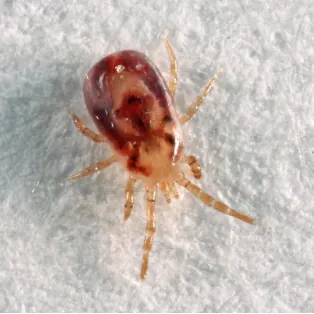
If you're being bitten at night in a Summerstrand flat, can feel something crawling but can barely see it, and there are birds nesting somewhere on the building, bird mites are a strong suspect. They're tiny, they come from a nest, and the treatment has to start at that nest, not in your bedroom.
What bird mites are
Bird mites are tiny parasites, roughly the size of a full stop, that live in birds' nests and feed on the birds' blood, mostly the chicks'. While the nest is busy, you'd never know they were there. When the young birds leave or die, or the nest is abandoned, the mites lose their food supply and spread out looking for a new host. That's when they wander through ceiling gaps, light fittings, air vents and window frames into homes.
They bite people and cause itching and small red spots, but they can't complete their life cycle on humans, and without birds they die off. The trouble is that a single nest can hold a lot of mites, so the wave coming indoors can be very unpleasant until it's dealt with.
Why flats in Summerstrand get them
Apartment blocks and hotels along the beachfront offer birds plenty of nesting spots: window ledges, the space behind and under air conditioning units, gaps under roof sheeting, parapet walls, gutters and the tops of downpipes. Pigeons are the usual culprits, though other birds that nest on buildings can bring mites too. The wind plays its part: birds look for shelter on the protected side of the building, which is often right next to someone's bedroom window.
Houses get bird mites too, usually from nests in the roof space where birds got in under a lifted tile or through an open eave.
Signs it's bird mites, not something else
- Bites or itching, often at night, with a crawling feeling on the skin
- Tiny moving specks on white surfaces such as windowsills, bedding or the bath, sometimes reddish after feeding
- Activity concentrated near a window, air conditioner, light fitting or ceiling gap close to a nest
- Pigeons or other birds nesting on the building recently, or a nest that's just been removed
Bed bugs and fleas cause similar complaints. Our page comparing the different biting pests in Summerstrand helps you tell them apart.
How we treat bird mites
- Find the nest. This is the key step. We check ledges, air conditioning units, roof spaces, gutters and eaves near where the bites are happening.
- Treat the nest and its surroundings with a targeted product to kill the mites at the source.
- Remove the nest where it can safely be reached, after treatment, so mites aren't scattered further.
- Treat the entry routes indoors, such as window frames, light fittings and ceiling gaps near the bedroom, so mites already inside are dealt with.
- Give proofing advice, so birds can't return to the same ledge or roof gap.
Nobody has to leave the flat for this. Just keep children and pets off treated surfaces until they're dry.
The mistake that makes it worse
Removing a pigeon nest without treating it. The moment the nest goes, every mite in it is looking for a new meal, and the nearest one is usually you. Treat first, then remove. The same goes for clearing birds out of a roof space: if the nest material stays behind untreated, the mites spread into the house.
For body corporates and hotels
Pigeons on a beachfront building are rarely limited to one flat. If several residents or guests are complaining about bites, the nests on the whole facade, roof and rooftop plant area need checking. Dealing with the building in one go works far better than going flat by flat.
A local tip
Look at your air conditioning unit. On many Summerstrand blocks, the gap between the outside unit and the wall, or the bracket underneath it, is a favourite pigeon nesting spot. Netting or spikes fitted by a handyman once the nest has been treated will keep them off.
Inside the flat while you wait
Until the source is treated, a few simple steps make nights easier. Wash bedding on a hot cycle, vacuum along windowsills and skirting near the affected room, and keep the bed pulled slightly away from the wall. Close windows near the nest if you can. None of this fixes the problem, but it reduces the mites reaching you.
What does it cost?
It depends on how many nests there are, how hard they are to reach and whether the treatment is for one flat or a whole building. A single nest on a ground-floor ledge is simple. Nests under roof sheeting on a multi-storey block, or spread across a hotel facade, take more time and access equipment. We quote once we've found the source.
For more detail, see the bird mite guide or bird mite treatment across Port Elizabeth. We also treat bird mites in Walmer homes, and the Summerstrand pest control overview covers the suburb's other pests.
Call 087 012 5550, or WhatsApp us a photo of the nest site and the specks you're seeing.
Questions we get asked
Can bird mites live on people?
No. They bite people, but they can't complete their life cycle on humans and die off without a bird host.
Will bird mites go away on their own?
Eventually, but it can take a while and a nest can release a lot of them. Treating the nest and entry points shortens the misery considerably.
Can you remove the pigeon nest for me?
Yes, where it can be safely reached. We treat it first so the mites don't scatter, then remove it.
Is it bird mites or bed bugs?
Bird mites are far smaller, barely visible, and the bites usually line up with a nest nearby. Bed bugs are seed-sized and hide in the bed itself. A photo helps us tell.
Should I see a doctor for bird mite bites?
If the itching is severe or the bites become infected, yes. A pharmacist can also suggest something to ease the itch while the nest is treated.