
The quickest way to waste money on insect control is to treat before you know what you're treating. A cockroach, an ant and a fishmoth may all turn up in the same kitchen cupboard, but they breed in different places, eat different things and respond to completely different products. Get the identification right and the treatment becomes simple. Get it wrong and you can spray every week without making a dent.
This guide covers the big picture: how household insects are grouped, why they keep coming back, and what proper treatment involves.
Three groups that cover most problems
It helps to sort household insects by how they live, because that decides how they're treated.
Insects that crawl and hide
Cockroaches, ants, fishmoths and silverfish spend most of their lives tucked into cracks, wall voids, cupboards and under appliances. You see a few; the rest stay hidden. Treatment has to reach where they shelter, usually with baits or a precisely placed residual product. Our guide to crawling insects goes into each one.
Insects that fly
House flies, fruit flies, drain flies, moths and mosquitoes. The adults are the visible problem, but they're the end of a life cycle that started in rotting food, wet drains, compost or standing water. Kill the adults and more emerge, so the work is finding and removing breeding sites. Read more in our flying insect guide.
Insects that bite
Fleas, bed bugs, mosquitoes and mites (which are not insects but are treated alongside them). These are the ones that affect sleep and health most directly, and the hardest to diagnose from bites alone. The guide to biting insects explains how to tell them apart.
Why insects are so hard to get rid of
Insects have survived for a very long time by being good at a few things. Knowing them explains why quick fixes rarely last.
- Eggs are protected. Cockroach eggs sit inside a tough case, flea eggs fall deep into carpet, fly eggs are buried in waste. Many sprays don't reach them, so a new generation hatches after the treatment.
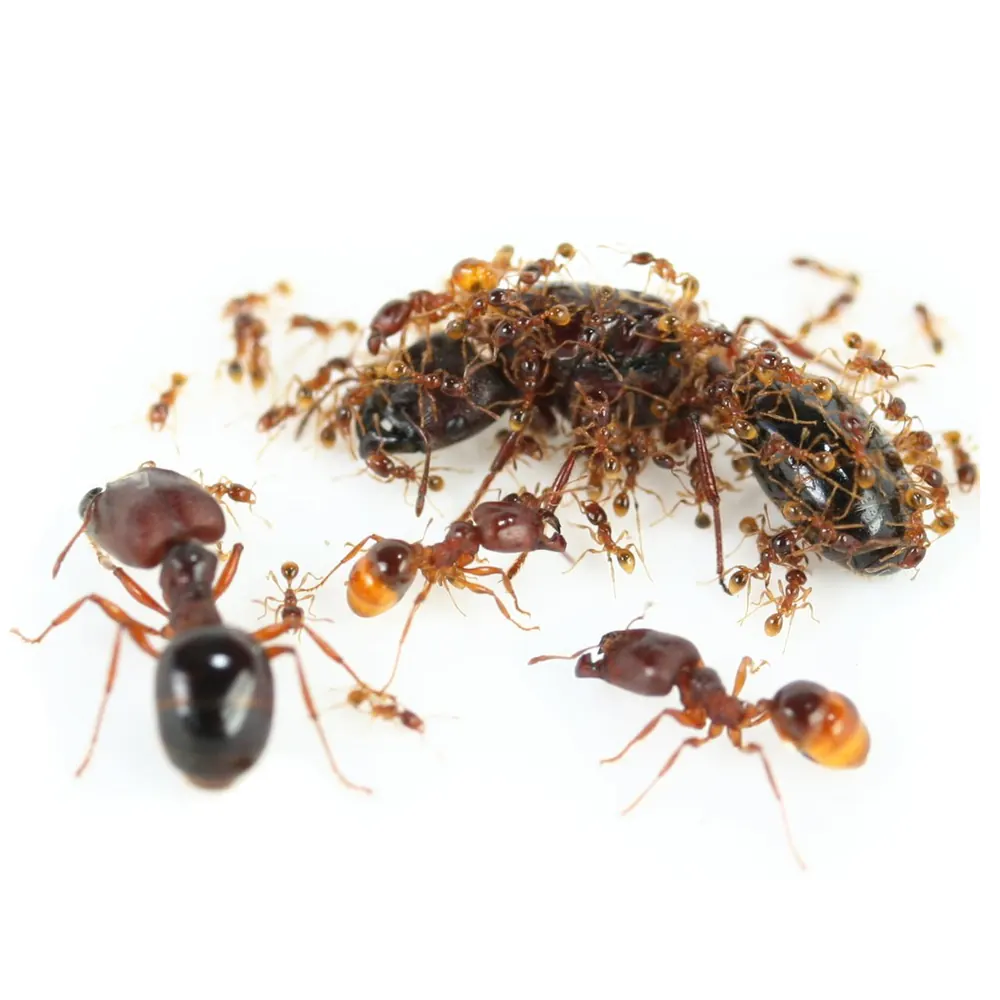
- Most of the population is out of sight. In an ant colony, the workers on the counter are a small share of the whole. The queen stays in the nest and keeps laying.
- They breed fast in warmth. On a mild, humid coast, many insects keep breeding for most of the year rather than shutting down for a long winter.
- They learn to avoid what doesn't work. Repeated use of the same product, or spray on top of bait, can teach a population to avoid treated areas or contaminate the bait.
The mistake almost everyone makes
Using an aerosol fly-and-crawling spray as the answer to everything. It kills what it hits, and that feels like progress. But it doesn't reach eggs or nests, it can scatter cockroaches deeper into walls, it can make ants split into new colonies, and it leaves a film that puts insects off any bait you or we place afterwards. A can of spray has its place for a single wasp or a cockroach on the floor. As a treatment plan, it usually makes the real fix slower.
What a proper insect treatment involves
- Identification. We confirm the species, from a sighting, a sample, droppings, damage or a photo you've sent.
- Inspection. We look for where they are breeding and sheltering, and for what's drawing them: moisture, food, clutter, gaps around pipes and doors.
- Choosing the method. Gel baits for cockroaches. Baits that ants carry back to the nest. Odourless, non-staining residual sprays applied to cracks, skirting and outside barriers where they're the right tool. Targeted nest treatment for wasps.
- Advice on the cause. Most insect problems have a cause you can fix: a leaking pipe, a damp cupboard, food stored in open packets, a gap under a door.
- Follow-up where the life cycle calls for it, so eggs that hatch later don't restart the problem.
With normal insect treatments you don't need to leave your home. Keep children and pets off treated surfaces until they're dry. Fumigation with registered fumigants is a separate, rarely needed service, and the sealed area has to be empty until it's cleared.
Health and damage
Some insects are mostly a nuisance. Others matter more. Cockroaches and flies move between drains, bins and food, carrying bacteria with them, and cockroach droppings are a known trigger for allergies and asthma. Fleas and bed bugs cause itchy bites and lost sleep. Fishmoths damage paper, books and fabrics. Wasps can cause serious reactions in people who are allergic to stings. For food businesses, any insect activity is a hygiene risk.
When DIY is enough
Being honest about it: a few ants on the counter in summer, a single wasp in the lounge or the odd fruit fly around the fruit bowl are often sorted by a bit of cleaning and a store-bought bait. Call in a professional when the problem keeps returning, when it's spreading through the house, when you can't identify what you're seeing, or when it's a business with food, staff or customers to think about.
What does it cost?
It depends on the insect, the size and type of building, how established the problem is and whether a follow-up is needed. Treating one kitchen for German cockroaches is a different job from treating a whole block of flats or a restaurant on a monitoring schedule. For the local picture, our insect treatments in Port Elizabeth page covers how we work across the Bay. We'll quote once we know what we're dealing with.
Not sure what you're looking at? WhatsApp us a photo and we'll identify it for you. Or call Pest Arrest on 087 012 5550. We've been doing this for 25 years.
Questions we get asked
How do I identify an insect I've found?
Take a clear, close-up photo next to something for scale, like a coin, and send it to us on WhatsApp. Most household insects can be identified from a good photo.
Are spiders and scorpions insects?
No, they're arachnids, with eight legs instead of six. They're treated differently because they don't feed on bait the way many insects do.
Do I have to leave home during insect treatment?
No. For normal insect treatments you can stay. Just keep children and pets off treated surfaces until they're dry.
Why do I see more insects right after a treatment?
Some treatments flush insects out of hiding before they die, and baits draw them out to feed. A short rise in activity is normal and usually fades within days.
How often should a home be treated for insects?
Only as often as there's a problem. Many homes need a treatment now and then. Food businesses usually benefit from scheduled visits.
Can insects become resistant to treatments?
Some can, especially cockroaches exposed to the same spray over and over. Rotating methods and using baits correctly helps avoid this.