
Bird mites are one of the most confusing pest problems people deal with, because the cause is almost never in the room where the biting happens. The mites live in bird nests in the roof, gutters, eaves or air vents. When the chicks leave or the nest is abandoned, the mites lose their food and go looking for another warm body. They wander through ceiling gaps, light fittings and vents into bedrooms and lounges. The fix starts at the nest, not on the bed.
What bird mites are
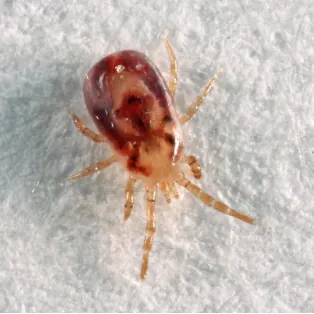
Bird mites are tiny arachnids, related to spiders and ticks, not insects. Adults are roughly the size of a full stop: pale or greyish when unfed, reddish after a blood meal. They move quickly, which is one of the easiest ways to spot them. People often notice them as moving specks on a white surface, a window sill, a bathroom basin or a pillowcase.
They feed on the blood of nesting birds and their chicks. In a busy nest they breed rapidly, and large numbers can build up over a nesting season.
Why they suddenly appear in your house
As long as there are chicks in the nest, the mites stay put. Things change when:
- The young birds fledge and leave the nest
- The chicks or adult birds die
- Someone removes the nest without treating it
- Birds are blocked out of the roof while mites are still inside
Then the mites spread out looking for a host. They'll bite people, but they can't complete their life cycle on human blood. That's why, once the source is dealt with, the problem does end.
Which birds are usually involved?
Any bird nesting in or on a building can carry mites, but pigeons, Indian mynas and sparrows are the usual suspects around homes, because they like to nest under roof tiles, in gutters, between ceiling and roof sheeting, in air vents and in gaps in fascia boards. In a windy city, lifted tiles and loose sheeting give them plenty of ways in. Starlings and other birds nesting in eaves can be a source too.
Signs it's bird mites
- Itchy bites, often at night, with no sign of bed bugs or fleas
- Tiny moving specks near windows, ceiling lights, cornices or air vents
- Birds nesting in the roof or gutters recently, especially if they've just gone quiet
- Bites concentrated in one or two rooms, usually below or beside the nest
- Specks found on light-coloured bedding or on the bathroom basin
Other biters can look similar at first, so it's worth ruling them out. Our guide to identifying biting insects explains how, and if you find spots on the mattress seams, our bed bug treatment page is the place to look instead.
Health effects
Bird mite bites cause itching and red marks, and some people react more strongly than others. They can make sleep difficult and scratching can lead to skin infections. If bites become infected or you're concerned, see a doctor. Bird mites are not known to cause serious disease in people, but the itching and stress of not knowing what's biting are very real.
The common mistake
Treating only the bedroom. People spray the bed, wash everything and even buy new bedding, and the bites carry on because new mites keep arriving from the nest. The second mistake is pulling a nest out of the roof without treating it first, which releases the mites all at once.
How professional bird mite treatment works
- Find the nest. We inspect the roof void, eaves, gutters, fascia boards and air vents to find where birds have been nesting, and check that mites are the cause.
- Treat the nest site with a targeted product before anything is moved, so mites are killed at the source.
- Remove the nest once it's been treated, where it can be reached safely.
- Treat the affected rooms, focusing on where mites are entering: cornices, light fittings, vents, window frames, skirting and around the bed. You don't need to leave home; keep children and pets off treated surfaces until dry.
- Advise on bird proofing so the next nesting season doesn't start it all again: closing gaps under tiles, fitting mesh over vents and fixing loose sheeting.
For the local service, see bird mite control in Port Elizabeth. Older homes with big trees and lots of birds are a common setting; our page on bird mites in Mill Park's older houses goes into that.
Prevention
Watch where birds are going in and out of your roof in spring, and close the gaps after the nesting season, once you're sure the nest is empty. Check the roof after strong winds for lifted tiles. Fit fine mesh over air bricks and vents. Don't feed pigeons near the house.
What does it cost?
The price depends on how many nests there are, how easy they are to reach, how many rooms are affected and how much proofing advice is needed. A single nest in an accessible gutter is a simpler job than several nests in a low, tight roof space. We'll quote after an inspection.
Itching and can't find the cause? Call Pest Arrest on 087 012 5550, or WhatsApp us a photo of the specks you're seeing.
Questions we get asked
Can bird mites live in my bed?
Not for long. They need birds to complete their life cycle, so they don't set up home in beds the way bed bugs do. They wander in from a nest nearby.
How long do bird mites survive without birds?
Usually only a few weeks without a bird host. Treating the nest and the house shortens that a lot.
Can I see bird mites?
Just. They're about the size of a full stop and move fast. You'll spot them most easily on white surfaces like basins, sills and pillowcases.
Should I remove the bird nest myself?
Not before it's treated. Pulling out an untreated nest releases the mites into the house. Treat first, then remove.
Do bird mites bite pets?
They may bite dogs and cats, but like with people, they can't breed on them. The source is still the bird nest.
Will bird mites come back next year?
Only if birds nest in the same spot again. Closing the gaps after the nest is dealt with is what stops it recurring.